On this page
- Saline rinses: the safest first move
- Steam and humidifiers
- Should you sleep propped up?
- Decongestant sprays: great for one night, risky for a week
- Oral decongestants and sleep
- Should you take a drowsy antihistamine to sleep?
- Menthol rubs and nasal strips
- A stuffy-nose night for kids
- When congestion is really snoring or apnea
- Common questions
The short answer Rinse your nose with saline before bed, sit in a steamy bathroom for a few minutes, run a clean humidifier, and prop your head up with an extra pillow. A decongestant spray can open things up for one night, but don’t use it for more than three days. Oral pseudoephedrine can keep you awake, and oral phenylephrine doesn’t work.
Most of these steps are cheap, and you can do them in the 30 minutes before bed. They’re listed roughly in the order we’d try them, starting with the ones with the fewest downsides.
- Rinse with saline before bed. A neti pot, squeeze bottle or saline spray flushes out mucus and allergens. Use only distilled, sterile or boiled-and-cooled water, never straight tap water (details below).
- Take a hot shower or sit in the steamy bathroom. The NHS suggests breathing in steam to ease a blocked nose this way. Blow your nose gently afterward.
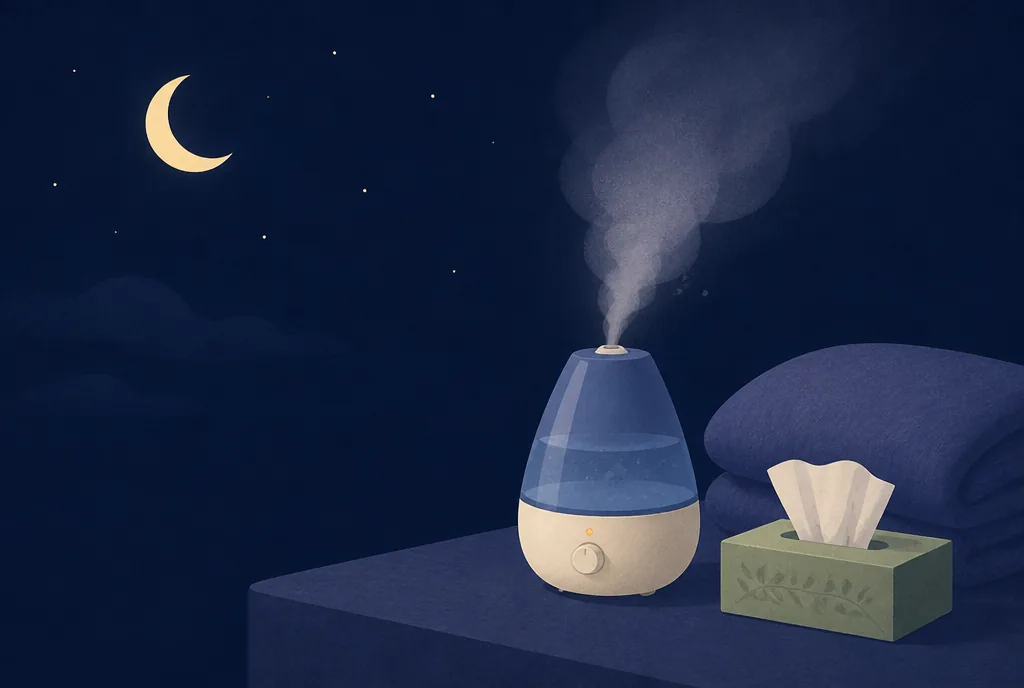
- Run a clean humidifier in the bedroom. Empty and refill it daily, and keep the room under 50% humidity.
- Prop up your head and shoulders. An extra pillow or a wedge lets mucus drain instead of pooling. Adults only; never prop up a baby.
- Use a decongestant spray for a night or two, if you need it. Oxymetazoline-type sprays work fast. Stop after three days.
- Time any oral decongestant early. Pseudoephedrine can cause trouble sleeping, so take the last dose several hours before bed.
- If it’s allergies, treat the allergy. Steroid nasal sprays and non-drowsy antihistamines target the cause.
- Keep water and tissues by the bed. Mouth breathing dries you out, and you’ll want both at 3 am.
Saline rinses: the safest first move
Rinsing works mechanically, so it suits almost everyone. The FDA says sinus rinsing can remove dust, pollen and debris, help loosen thick mucus, and relieve nasal symptoms of colds, flu, allergies and sinus infections. The NHS lists salt water nose rinses among the treatments a pharmacist may suggest.
The water rule is not optional. Tap water can carry organisms that are harmless to swallow but can cause serious infections in your nasal passages, and in rare cases fatal ones. The FDA says to use distilled or sterile water, or tap water boiled for 3 to 5 minutes and cooled to lukewarm. Boiled water keeps for 24 hours in a clean, closed container. Wash the device and let it dry between uses.
The technique: lean over a sink, tilt your head sideways, breathe through your mouth, and pour into the upper nostril so it drains out the lower one. Then switch sides. If you’d rather not pour water through your head before bed, a simple saline spray is a gentler option.
Steam and humidifiers
Steam is a standard home remedy, and the NHS recommends sitting in the bathroom with a hot shower running to ease a blocked nose. The research is thin, though. A Cochrane review of six trials found it uncertain whether heated, humidified air relieves cold symptoms, with low-quality evidence and no sign of harm. Treat steam as comfort, not treatment. Don’t let children breathe steam from a bowl of hot water; the NHS warns about scalding.
A humidifier is mostly about the long night ahead. The CDC lists a clean humidifier or cool mist vaporizer among the ways to feel better with a cold. The word “clean” is doing work there. The EPA advises emptying, drying and refilling portable humidifiers daily, cleaning them every third day, using low-mineral water such as distilled, and keeping indoor humidity at or below 50%, since damper air encourages mold and dust mites.
Should you sleep propped up?
For adults, it’s a reasonable free experiment. Many people find a couple of pillows or a foam wedge makes breathing through the nose easier. We couldn’t find a good trial measuring it, so try it for a night and judge for yourself. Raise your upper body from the waist rather than just bending your neck forward on a stack of pillows.
Babies are different. The American Academy of Pediatrics says any surface that inclines more than 10 degrees isn’t safe for a baby to sleep on, and that babies belong on their backs on a firm, flat surface with no pillows, even when they’re congested.
Decongestant sprays: great for one night, risky for a week
Sprays like oxymetazoline shrink swollen blood vessels in the nose and work within minutes. They also come with a firm limit. MedlinePlus says not to use oxymetazoline for longer than 3 days and no more than twice in 24 hours, because overuse can make congestion worse or make it come back.
It shouldn’t be used in children under 6 unless a doctor recommends it. Saline sprays don’t carry that rebound risk, so you can use them as often as you like.
Oral decongestants and sleep
Pseudoephedrine does relieve congestion. It’s also a stimulant. MedlinePlus lists nervousness, restlessness and difficulty sleeping among its side effects and advises taking the last dose of the day several hours before bedtime. If you have high blood pressure, heart disease or take other medicines, check with a pharmacist first.
Phenylephrine pills are the ones on the open shelf, and they’re a poor bet. After reviewing the data, the FDA proposed removing oral phenylephrine as a decongestant ingredient because it isn’t effective for nasal congestion. That proposal hadn’t been finalized as of FDA’s last update, so the products are still for sale. Phenylephrine nasal spray isn’t affected.
Should you take a drowsy antihistamine to sleep?
It’s tempting: diphenhydramine dries up a runny nose and makes you sleepy. But the drowsiness can carry into the next morning, and it adds to the effect of alcohol. MedlinePlus says diphenhydramine generally shouldn’t be used in older adults except for serious allergic reactions, because it isn’t as safe or effective as other options. For insomnia itself, the American Academy of Sleep Medicine suggests against diphenhydramine.
If allergies are behind your stuffy nose, the NHS lists antihistamines, steroid nasal sprays and salt water rinses as the main options. Steroid sprays don’t work right away: the NHS says one common spray takes a few days to take full effect, and some people need 2 weeks or more. They’re a plan for this week, not a rescue for tonight.
Menthol rubs and nasal strips
Menthol makes your nose feel clearer more than it makes it clearer. In a double-blind trial of 62 people with colds, an 11 mg menthol lozenge didn’t change measured airflow resistance at all, but people reported their nose felt much more open within 10 minutes. If that feeling helps you drift off, fine. Check the label age limits before using any menthol or camphor product on a child.
External nasal strips pull the sides of the nose outward. A 2026 meta-analysis of 17 studies in people with snoring or sleep apnea found no significant change in nasal airway resistance or breathing measures. They’re harmless to try, but don’t expect much from them on a cold.
A stuffy-nose night for kids
Children’s congestion is mostly a saline-and-patience situation.
- Saline and suction. The AAP suggests saline drops or spray to loosen mucus, then suction with a bulb syringe or having your child blow their nose.
- Honey for a cough, age 1 and up only. Never give honey to a baby under 1. For older children the AAP suggests 2 to 5 mL as needed.
- Skip the cold medicine for young kids. The AAP says over-the-counter cough and cold medicine isn’t recommended under age 4, and from 4 to 6 only if your child’s doctor recommends it. The CDC advises against OTC cough and cold medicines for children younger than 6.
- Humidifier, yes; propped mattress, no. Safe-sleep rules still apply when your baby is congested.
When congestion is really snoring or apnea
A cold-related stuffy nose is temporary. If you’ve been told you snore loudly most nights, with or without a cold, that’s a separate problem with its own fixes; see how to stop snoring. If you share a bed with someone whose cold has turned them into a chainsaw, sleeping next to a snoring partner has practical options for this week.
When to see a doctor
- Your cold symptoms haven’t improved after 10 days, or they got better and then worse again.
- You have a fever lasting more than 4 days (CDC), or a high temperature for more than 3 days (NHS).
- You have trouble breathing, fast breathing, or signs of dehydration. Seek care promptly for a baby or young child with these.
- Blocked nose, facial pain or pressure, or catarrh that lasts more than a few weeks. That can be chronic sinusitis, nasal polyps or allergies that need proper treatment.
- Loud snoring with gasping or pauses in breathing when you don’t have a cold. That needs a sleep apnea evaluation.
If you’re awake at 3 am anyway, how to fall back asleep has steps that work even with a stuffy nose. More practical guides live in Life Situations.
Common questions
What is the fastest way to unblock a stuffy nose at night?
A decongestant spray such as oxymetazoline works within minutes, but don't use it for more than 3 days or congestion can rebound. A saline rinse and a few minutes in a steamy bathroom are gentler options you can use every night.
Is it better to sleep propped up with a stuffy nose?
Many adults find it easier to breathe with the upper body raised on extra pillows or a wedge, though it hasn't been well studied. Babies should always sleep flat on their backs, even when congested.
Can I use a neti pot with tap water?
No. The FDA says to use distilled or sterile water, or tap water boiled for 3 to 5 minutes and cooled, because tap water can carry organisms that cause serious nasal infections.
Why can't I sleep after taking a decongestant?
Pseudoephedrine is a stimulant and can cause restlessness and difficulty sleeping. MedlinePlus advises taking the last dose of the day several hours before bedtime.
Written and checked by the Sleep Brief editors. We base every article on published research and guidance from medical bodies, and link the sources inline. How we research.
This article is for general education and isn't medical advice. If poor sleep lasts more than a few weeks, or you snore loudly, stop breathing in your sleep or feel sleepy while driving, talk to a doctor.