On this page
- Do earplugs actually help you sleep?
- Foam earplugs: the most noise blocking, if you insert them right
- Silicone earplugs: comfort first
- Wax earplugs: the softest option
- What the noise rating on the package means
- Which earplug type is best for snoring?
- Is it bad to sleep with earplugs every night?
- How to choose: a quick decision guide
- Common questions
The short answer Foam earplugs are the default for sleep: they expand to seal inside the ear canal, they’re what sleep studies have tested, and they block the most noise when inserted properly. Moldable silicone and wax sit over the canal opening instead, which many side sleepers and people with small or sensitive ears find more comfortable, at the cost of a less certain seal.
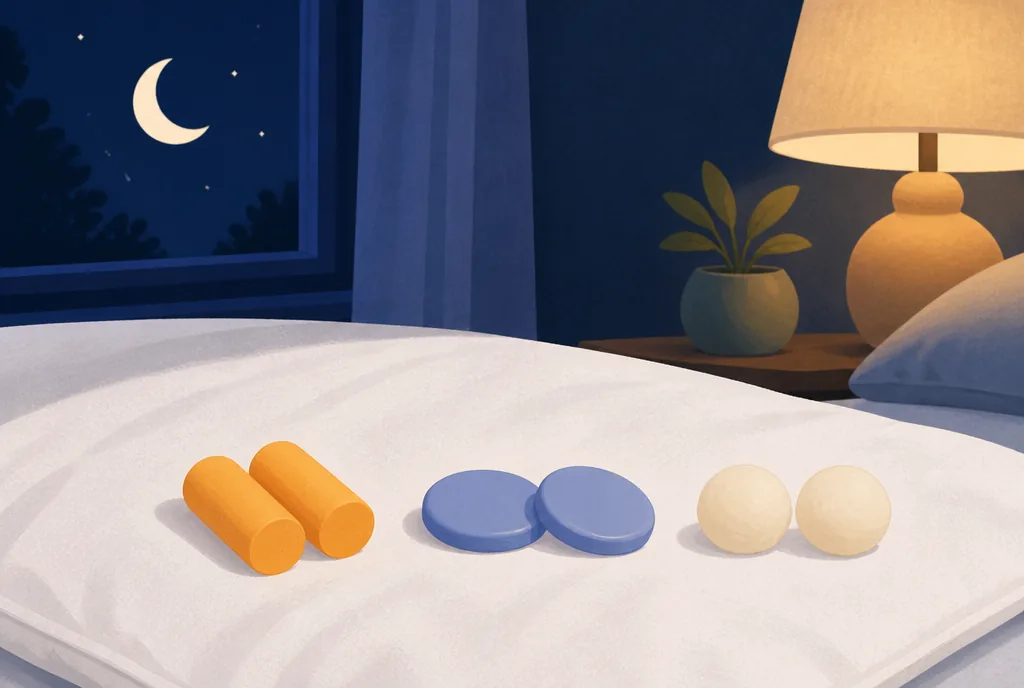
The three types work in different ways, and that difference explains most of the trade-offs. Foam goes inside the canal. Moldable silicone and wax press over the entrance, like a soft cap.
| Foam | Moldable silicone | Moldable wax | |
|---|---|---|---|
| How it seals | Rolled thin, inserted, then expands inside the canal | Pressed over the canal opening, not pushed in | Warmed and pressed over the canal opening |
| Noise blocking | Highest when fitted well; tested in sleep lab studies | Depends heavily on the seal; little independent testing | Depends heavily on the seal; little independent testing |
| Side sleeping | Fine if fully inserted; pressure if it sticks out | Flat profile, often comfortable | Flat profile, often comfortable |
| Feel | Gentle pressure inside the ear | Nothing inside the canal | Nothing inside the canal; softer and stickier |
| Reuse | Washable and reusable for a while | A few nights, until it collects lint | A few nights, until it collects lint |
| Watch out for | Shallow fit, earwax buildup with nightly use | Can loosen overnight; residue in hair | Can loosen overnight; residue on pillow |
| Best for | Snoring partners, traffic, maximum quiet | Sensitive ears, small canals, side sleepers | Sensitive ears, people who find silicone too firm |
None of these are brand recommendations. Within each type, products differ in size, softness and rated noise reduction, so the fit tips below matter more than the label.
Do earplugs actually help you sleep?
Yes, with the right noise and a decent fit. A 2026 lab study in the journal Sleep exposed 25 healthy adults to recorded traffic-type noise across seven monitored nights. Standard foam earplugs mitigated nearly all of the noise effects on sleep, including most of the lost deep sleep. Pink noise played in the background, by contrast, didn’t protect sleep and cut REM.
The same study shows the limits. Earplugs started failing at the loudest noise level tested, 65 decibels at peak, and the measured noise reduction varied hugely between people: an average of 25.5 dB, but anywhere from about 11 to 42 dB. That spread is mostly fit.
In hospitals the evidence is weaker. A Cochrane review of sleep in intensive care found that earplugs, eye masks or both were linked to more total sleep in two small pooled studies, but rated the evidence low quality, and most studies measuring sleep objectively found no benefit.
Foam earplugs: the most noise blocking, if you insert them right
Foam is a “formable” plug. It only works if most of it ends up inside your ear canal. NIOSH, the federal agency for workplace safety, gives a four-step method in its earplug fitting guide:
- Roll the plug between your thumb and fingers into a thin, smooth, crease-free cylinder.
- Reach over your head with the other hand and pull the top of your ear up and back. This straightens the canal.
- Insert the rolled plug into the straightened canal.
- Hold it in place for a few seconds while it expands.
NIOSH’s size rule is useful at bedtime too: if you can’t get at least half the plug into the canal, or it won’t expand enough to stay firmly seated, you need a different size. When the plug is in properly, your own voice should sound deeper or hollow.
A plug that sits half outside your ear is the most common failure, and it’s also what makes foam uncomfortable for side sleepers, because the pillow presses the exposed part into the ear. A slimmer or smaller plug often fixes both problems.
Foam plugs are sold as disposable, but NIOSH notes they can be washed and used repeatedly. Swap them when they stop expanding slowly, look grubby or feel different.
Silicone earplugs: comfort first
“Silicone earplugs” covers two different products, so check which one you’re buying.
Moldable silicone putty is the soft kind you shape into a ball and flatten over the ear canal opening. Package directions for these warn against pushing them into the canal. Because nothing sits deep in the ear, many people who can’t tolerate foam find them easier to sleep in, and they keep water out, which is why they’re also sold for swimming. The downside is the seal: it depends on how well you press the putty into the folds around the opening, and it can loosen as you move during the night.
Pre-shaped silicone plugs, often with stacked flanges, are a different thing. NIOSH calls this style pre-formed, shaped to fit most ears. They’re reusable and easy to wash, but the stem often sticks out, which side sleepers tend to notice.
Wax earplugs: the softest option
Wax plugs work like moldable silicone. You warm one in your fingers until it softens, then press it over the canal opening to form a seal. They’re softer and slightly sticky, so they mold closely to the folds around the opening. They can leave a residue on hair and pillowcases and lose their shape after a few nights.
We couldn’t find independent tests comparing wax with silicone putty for noise or sleep. For now, the choice between them comes down to which one stays put and feels better in your ears.
What the noise rating on the package means
US hearing protectors carry a Noise Reduction Rating (NRR) measured in a lab. Real-world protection is usually lower. NIOSH says the rating often does not reflect the actual protection people get, and OSHA acknowledged that the NRR often overstated protection for workers. For estimating field performance, OSHA’s method subtracts 7 and then halves the result.
Run that on two hypothetical boxes. An NRR of 33 works out to roughly 13 dB of real-world reduction; an NRR of 22, about 7.5 dB. Those are rough workplace estimates, not sleep predictions, but they show why a higher number on the box matters less than getting a good seal. NIOSH suggests a simple check: count out loud while cupping and uncupping your hands over your ears. With a good fit, your voice should sound about the same either way.
Earplugs can make your own heartbeat and breathing sound louder. That’s the occlusion effect: sealing the canal boosts low-pitched body sounds that travel through bone. It’s a side effect of a sealed ear, not a sign the plug is damaging anything.
Which earplug type is best for snoring?
Snoring is loud, uneven and right next to you, which is the toughest case. Start with foam, fitted deeply, because that’s the type with sleep-lab evidence behind it. If foam won’t stay comfortable, try moldable silicone or wax next.
Earplugs alone may not be enough if the snoring peaks are very loud; the 2026 study saw protection fade at the highest noise level. Our guide to sleeping with a snoring partner covers what to add, and how to stop snoring is worth passing along to the snorer.
Is it bad to sleep with earplugs every night?
For most people, nightly use is reasonable with a few habits. The main known risk is earwax. Cleveland Clinic lists frequent use of earplugs among the things that make impacted earwax more likely, along with hearing aids and earbuds.
- Insert plugs with clean hands. NIOSH notes that dirt can irritate the ear canal.
- Let washed plugs dry completely; wet plugs can irritate ears.
- Take foam out slowly with a gentle twist to break the seal, instead of yanking it.
- Replace any plug that’s torn, hardened or dirty.
- Don’t dig out wax with cotton swabs. If your ears feel full or blocked, see a clinician.
- Store plugs away from small children. A foam earplug once caused a bowel obstruction in a 7-month-old.
- Check that you can still hear your smoke alarm and your morning alarm with plugs in.
When to see a doctor
Stop using earplugs and see a doctor if you have ear pain, itching, discharge, ringing in the ears, dizziness, or muffled hearing that lasts after you take them out. Those can signal impacted wax or an ear infection. If noise isn’t the real reason you’re waking, and you’ve had trouble sleeping at least three nights a week for three months, that’s chronic insomnia, which deserves its own evaluation.
How to choose: a quick decision guide
- You want the most quiet: foam, sized so most of it fits in the canal.
- Foam hurts or keeps popping out: try a smaller or slimmer foam first, then moldable silicone.
- You sleep on your side and feel pressure: moldable silicone or wax, or foam inserted deeper.
- You hate anything inside your ear: moldable silicone or wax.
- You use them every night for years: ask an audiologist about custom plugs, which NIOSH describes as made from an impression of your own ear.
Light is the other half of a dark, quiet room. If it’s waking you too, see how to choose a sleep mask. If you’d rather cover noise than block it, read our comparison of white, pink and brown noise first, keeping in mind the 2026 study’s finding on REM. More gear guides are in Sleep Gear.
Common questions
Are silicone or foam earplugs better for sleeping?
Foam usually blocks more noise when inserted properly, and it's the type tested in sleep studies. Moldable silicone sits over the ear canal opening instead, which many people with sensitive ears or who sleep on their side find more comfortable.
Do wax earplugs work for sleep?
They can. Wax plugs are softened in the fingers and pressed over the canal opening, much like silicone putty. There's little independent testing of how much noise they block, so the seal you get matters most.
Is it bad to sleep with earplugs every night?
Most people can use them nightly with clean hands and clean, dry plugs. Frequent earplug use makes impacted earwax more likely, so see a clinician if your ears feel blocked, hurt, itch or drain.
How long do foam earplugs last?
They're sold as disposable, but NIOSH notes they can be washed and reused. Replace them when they no longer expand slowly, look dirty or feel different.
Written and checked by the Sleep Brief editors. We base every article on published research and guidance from medical bodies, and link the sources inline. How we research.
This article is for general education and isn't medical advice. If poor sleep lasts more than a few weeks, or you snore loudly, stop breathing in your sleep or feel sleepy while driving, talk to a doctor.