On this page
The short answer Your first night somewhere new is usually your worst, and that’s normal. Researchers call it the first-night effect: part of your brain stays on watch in an unfamiliar room, so you take longer to fall asleep and wake more easily. It usually fades by the second night. Control the light, noise and temperature you can, and keep your wake time.
Two lists below: one for you as the guest, one for whoever is making up the guest room. Print the second one and leave it on the fridge if you’re hosting this year.
Guest checklist: what to pack and do
- An eye mask. Guest rooms often have thin curtains, a streetlight outside, or a charger glowing on the dresser. See how to choose a sleep mask if you don’t own one.
- Earplugs. Pack two pairs; one always rolls under the bed. Our foam vs silicone vs wax guide covers which type suits side sleepers.
- A white noise app or small fan to cover a creaky house, a dog, or a TV through the wall.
- Your own pillow, or at least your pillowcase, if you have room. No study proves it helps, but it’s one less unfamiliar thing.
- Layers for sleep. Pajamas you can strip down or add to, plus socks, because you don’t control the thermostat.
- A small flashlight or your phone’s light for the first trip to an unfamiliar bathroom.
- Keep your usual wake time, within an hour or so, even on the days off.
- Ask about the room before you need it: where the extra blanket is, how the thermostat works, and which way the bathroom is.
- Go easy on late coffee and nightcaps. The American Academy of Sleep Medicine (AASM) advises no caffeine in the afternoon or evening and no alcohol before bedtime.
Host checklist: a guest room people sleep well in
- Cool, with options. Aim for roughly 60 to 67°F, the range a Cleveland Clinic sleep psychologist gives for most adults. Older guests may prefer it warmer, so ask.
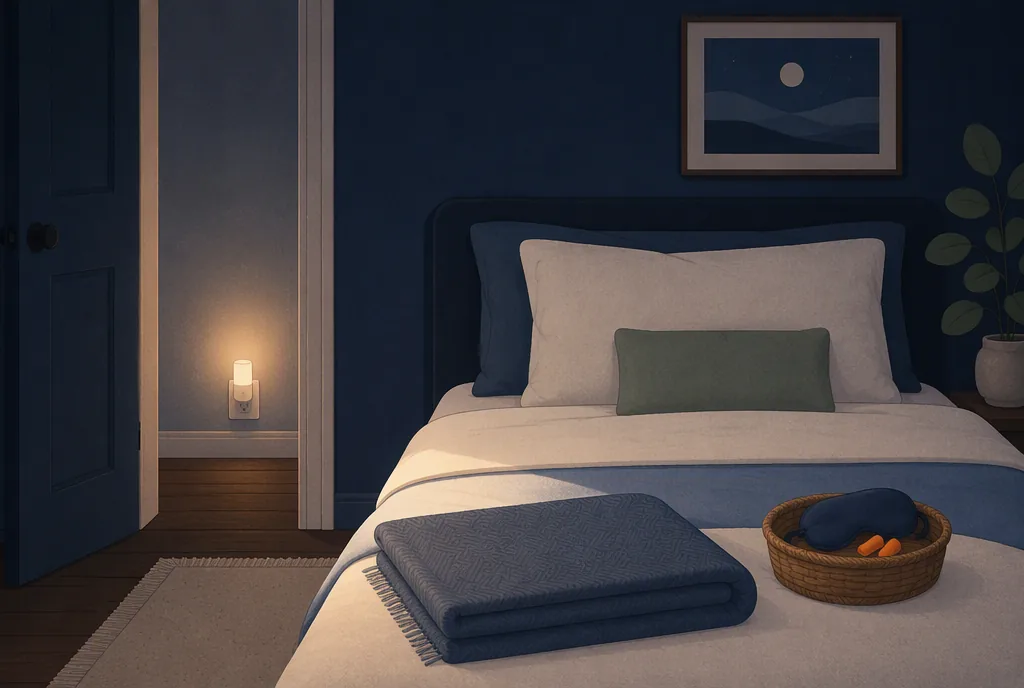
- Extra blankets in plain sight, folded at the foot of the bed, so nobody has to go looking at 2 a.m.
- Dark. Close the blinds, turn the clock face away or unplug it, and check for standby lights on a TV or router.
- A night-light path to the bathroom. Plug-in lights low in the hallway and bathroom let a guest find the way without flipping on an overhead light.
- A lamp the guest can reach from bed, so they aren’t crossing a dark room to a wall switch.
- Earplugs and an eye mask set out in a basket on the nightstand, still in their packaging.
- Quiet after a set time. Tell guests when the house goes quiet and when the first person usually gets up, and warn them about anything loud: an early dishwasher, a furnace that clicks on, a dog that barks at dawn.
- The basics written down: Wi-Fi, thermostat, towel spot, and where the water glasses are.
- A safe space for any baby who visits (more on that below).
Why you sleep worse in someone else’s house
Sleep scientists have known about this for a long time, because it messes up their lab studies. The classic 1966 lab study by Agnew, Webb and Williams found that the first night in a sleep lab had more time awake and less REM sleep, and that the effect mostly disappeared by the second night.
A 2022 meta-analysis pooled 53 studies with 1,422 healthy people aged about 9 to 85. On the first night, people took longer to fall asleep, spent more time awake after falling asleep, and got less total sleep and less REM than on the second night. Deep sleep didn’t change much. By the second and third nights, most measures had settled down. Young adults in their 20s showed the smallest effect.
One half of your brain stays on night watch
In 2016, a team at Brown University (Tamaki, Bang, Watanabe and Sasaki) published a study in Current Biology that offered an explanation. They recorded 35 young, healthy volunteers over two lab sessions about a week apart. On the first night, the left hemisphere slept more lightly than the right during deep sleep. The authors described it as one hemisphere being more vigilant than the other “as a night watch”.
That lighter-sleeping half also reacted more strongly to odd, unexpected sounds played during sleep. Volunteers woke more often and responded faster to those sounds when they were played to the left hemisphere, and the bigger the imbalance between hemispheres, the longer people took to fall asleep. By the second session, the imbalance was gone.
The authors point out that some birds and marine mammals sleep with one half of the brain at a time as protection. Their results suggest humans keep a milder version for unfamiliar places.
It may not be only about the room. A 2024 study in Sleep found first-night disruption in people’s own homes as well as in the lab when they wore recording equipment, which hints that any novel night can trigger it. People with insomnia show the effect too, according to a 2024 meta-analysis.
What helps on the first night
You can’t switch off a brain that’s checking for danger. You can give it less to check.
Light
The AASM recommends limiting bright light in the evening and turning off screens at least 30 minutes before bed. In a strange room, an eye mask is the fastest fix, because you can’t rearrange someone else’s curtains. Leave a dim light on in the hall or bathroom if your host will let you, so a 3 a.m. bathroom trip doesn’t mean the overhead light.
Noise
Unfamiliar sounds are exactly what the night-watch hemisphere responds to. A furnace you’ve never heard before registers as news; your own furnace doesn’t. Earplugs blunt the sharp sounds, and a steady sound from a fan or an app masks the irregular ones. Try a few sounds in the app before bed and keep the one you notice least.
The combination has some support. In a small lab study, 14 healthy adults slept with recorded intensive-care noise and light. With earplugs and an eye mask, they had more REM sleep, fewer arousals and higher melatonin levels. A guest room is far quieter than an ICU, but the principle carries over.
Temperature
The AASM simply says to keep the room at a comfortable, cool temperature. As a guest, you control your layers, not the thermostat. Sleep in light layers under the blankets and add or drop one as needed; socks help if your feet run cold. Our bedroom temperature guide has the details if you’re the host and want a number.
Routine
Your bedtime routine is one of the few familiar things you can bring. Same order, same rough timing: wash up, read for a while, lights out.
Keep the wake time steady too. The AASM’s first tip is to get up at the same time every day, even on weekends or during vacations. Sleeping until 10 after a bad first night makes the second night harder.
If you’re lying awake
Don’t fight it for hours. The AASM’s advice is that if you don’t fall asleep after 20 minutes, get out of bed and do a quiet activity in low light, away from screens. In someone else’s house, that might mean sitting in a chair with a book and a small reading light. More tactics are in how to fall back asleep.
And remember the research: the second night is usually better. Knowing that makes a rough first night less of a worry, and worrying about sleep is its own problem.
Sleeping on an air mattress or sofa
A temporary bed adds its own problems, but most are fixable.
- Air mattress: inflate it a few hours early so it can stretch, then top it up right before bed. Put a folded blanket or comforter between you and the mattress; a thin sheet over a cool air mattress can leave you chilly, and the extra layer also softens the seams.
- Sofa: a sofa that’s shorter than you are means bent knees all night. Wedge a pillow between your knees if you sleep on your side, and ask whether the cushions can come off to make the surface flatter.
- Floor or living room: these are the noisiest, brightest spots in the house, since everyone walks through in the morning. The mask and earplugs matter most here. Ask your host when the first person usually gets up.
Sharing a room or a bed
Holidays mean doubling up: siblings in bunks, cousins on a pull-out, you and a partner in a full-size bed. A few things make it easier.
Agree on lights out before you’re both in the room. Bring your own blanket if the other person runs hot or cold; two separate covers on one bed save a lot of tugging. If the other person snores, earplugs are the first move, and a steady fan or noise app on your side of the room helps cover the rest.
When a kid is sharing your room, put them to bed first and get yourself ready in the bathroom, so you’re not turning on lights over a sleeping child.
Hosting older guests or a baby
Night lights matter more for older guests, who are likelier to get up at night in an unfamiliar house. The National Institute on Aging suggests night lights and light switches close to the bed, a light left on in the bathroom or one that turns on automatically, and a flashlight by the bed. Clear the path of shoes, bags and loose rugs before they arrive.
For babies, a guest bed is not a safe place to sleep. The NIH’s Safe to Sleep campaign says couches, sofas, air mattresses and pillow-top mattresses are not safe for babies, because a baby can get wedged or be unable to breathe. Babies need a firm, flat surface such as a crib, bassinet or portable play yard that meets safety standards. If family is bringing an infant, ask whether they’re bringing a play yard, and clear floor space for it.
When to see a doctor
If you sleep badly every night, at home as well as away, the problem probably isn’t the guest room. Talk to a doctor if poor sleep lasts three months or more, if someone notices you snore loudly or stop breathing in your sleep, or if you’re sleepy during the day even after a full night in your own bed.
If the holidays are also why you’re lying awake, read our guide to holiday stress and sleep next. More guides on sleeping through travel, shifts and new family arrangements are in our life situations section.
Common questions
Why can't I sleep the first night in a new place?
It's called the first-night effect. A 2016 Brown University study found one brain hemisphere stays more alert during deep sleep on the first night in a new place, reacting more to unusual sounds. It usually fades by the second night.
How long does the first-night effect last?
Usually one night. A 2022 meta-analysis of 53 studies found most sleep measures were back to normal by the second and third nights.
What temperature should a guest room be?
A Cleveland Clinic sleep psychologist suggests about 60 to 67°F for most adults. Older guests often prefer it warmer, so ask, and leave extra blankets out either way.
Is it safe for a baby to sleep on an air mattress or couch?
No. The NIH Safe to Sleep campaign says couches, sofas and air mattresses are not safe for babies. Use a crib, bassinet or portable play yard with a firm, flat surface.
Written and checked by the Sleep Brief editors. We base every article on published research and guidance from medical bodies, and link the sources inline. How we research.
This article is for general education and isn't medical advice. If poor sleep lasts more than a few weeks, or you snore loudly, stop breathing in your sleep or feel sleepy while driving, talk to a doctor.