On this page
The short answer Sleep hygiene is the set of daily habits that make good sleep easier: a fixed wake time, daylight, caffeine cut off by early afternoon, no alcohol near bedtime, a cool dark bedroom and getting up when you can’t sleep. Below are 15 habits from sleep medicine guidance, in a checklist you can print.
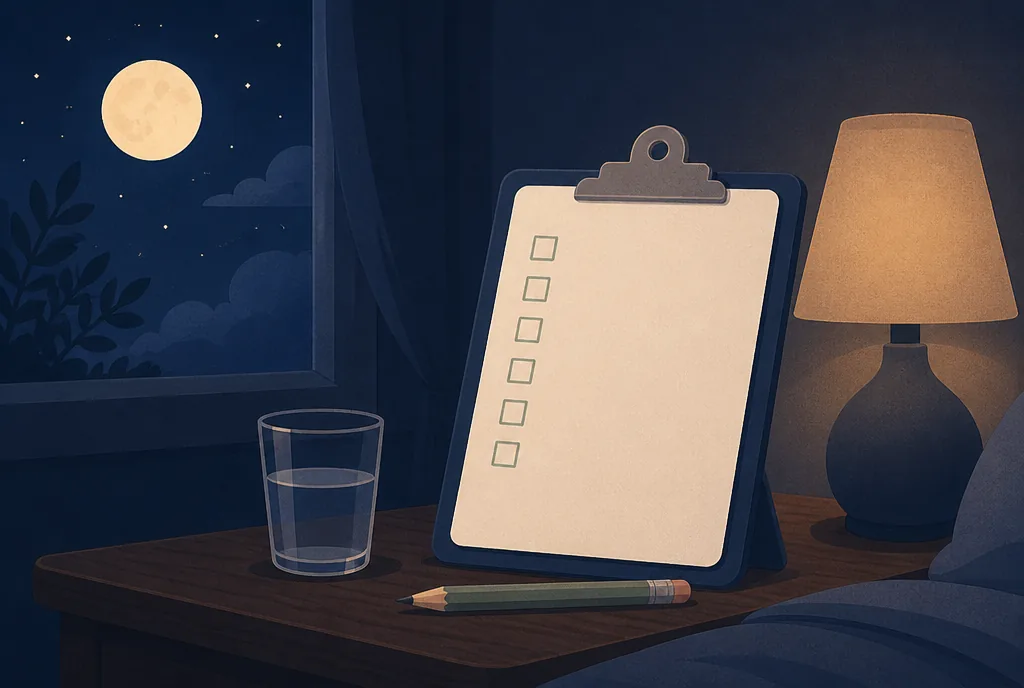
Every item on this list comes from the American Academy of Sleep Medicine, the National Heart, Lung, and Blood Institute or the CDC, with the research linked further down. Print the page, or screenshot the list, and tick off what you already do. The gaps are your to-do list.
The checklist
During the day
- Get up at the same time every day, weekends and vacations included, and go to bed early enough for at least 7 hours.
- Get outside in daylight for some part of every day.
- Exercise regularly, but skip intense workouts right before bed.
- No caffeine in the afternoon or evening. Coffee, tea, soda, energy drinks and chocolate all count.
- Keep naps to 20 minutes or less.
- Avoid nicotine, from cigarettes or vapes.
In the evening
- No large meal close to bedtime. A light snack is fine if you’re hungry.
- Skip alcohol before bed.
- Cut back on fluids before bed so you’re not up to use the bathroom.
- Dim the lights in the evening.
- Screens off at least 30 minutes before bed.
- Use the last hour for a quiet, repeatable wind-down: a warm shower, reading, stretching.
In the bedroom
- Keep the room cool, quiet and dark.
- Use the bed only for sleep and sex, and go to bed only when you feel sleepy.
- Can’t sleep after about 20 minutes? Get up, do something quiet in dim light without screens, and come back when you’re sleepy.
Where each habit comes from
Most of the list is the AASM’s own patient advice, which tells you to keep a consistent schedule, go to bed only when sleepy, get out of bed after 20 minutes awake, use the bed only for sleep and sex, limit bright light in the evening, turn off devices at least 30 minutes before bed, skip large meals, caffeine late in the day and alcohol before bedtime, and reduce fluids before bed. The CDC’s list covers the same ground in shorter form.
The NHLBI adds a few: spend time outside every day, avoid nicotine as well as caffeine, use the hour before bed for quiet time, and keep adult naps to no more than 20 minutes.
The habits with the most behind them
Not every box carries equal weight. If you can only change a few things, we’d start with these, because the research is strongest.
A fixed wake time and getting up when you can’t sleep
These two come from stimulus control, a behavioral treatment the AASM’s 2021 insomnia guideline suggests as a stand-alone treatment. The logic: your brain learns what the bed is for. Lie awake in it for hours and it learns the wrong thing. Getting up resets the link, and a steady wake time keeps your body clock from drifting. Use the sleep calculator to work back from your wake time to a bedtime.
Caffeine timing
“Afternoon” is vague, so here’s the number. A 2023 meta-analysis found caffeine cut total sleep by 45 minutes and calculated that a regular coffee should be finished at least 8.8 hours before bed. In an earlier trial, 400 mg of caffeine taken six hours before bed still cut measured sleep by more than an hour. For an 11 pm bedtime, that puts your last coffee around 2 pm. Our caffeine calculator shows what’s left in your system at bedtime.
Alcohol
A drink helps you fall asleep, which is why it’s tempting. A review of the research in healthy volunteers found alcohol shortens the time to fall asleep at all doses but increases disruption in the second half of the night. If you keep waking in the early hours, check what you drank the evening before.
A cool, dark room
The AASM recommends a comfortable, cool temperature, and a Cleveland Clinic sleep psychologist suggests 60 to 67°F (15 to 19°C). Darkness matters too: in a lab study, one night of sleeping with moderate room light raised heart rate and next-morning insulin resistance compared with dim light. More on this in the best temperature for sleep. If light leaks in and you can’t fix the windows, a sleep mask is a cheap workaround; see how to choose a sleep mask.
What sleep hygiene can’t do
Here’s the honest part. For chronic insomnia, sleep hygiene alone isn’t enough. The same AASM guideline suggests that clinicians not use sleep hygiene as a single-component therapy for chronic insomnia in adults. Instead it strongly recommends cognitive behavioral therapy for insomnia (CBT-I), which includes these habits alongside stimulus control, sleep restriction and work on the thoughts that keep you up.
The AASM’s patient site describes sleep hygiene as an important part of CBT for people with insomnia. So treat the checklist as the foundation, not the whole house. It helps most people sleep better, and it’s where CBT-I starts, but if you’ve had trouble sleeping for months, the checklist on its own probably won’t fix it.
Don’t try to perfect all 15 at once. Changing everything makes it hard to tell what helped, and turning sleep into a project can raise the very stress that keeps you awake.
How to use the checklist
- Score yourself honestly. Tick the habits you already keep on most days, not the ones you keep on good days.
- Pick two or three gaps. Start with the wake time, plus whichever of caffeine, alcohol or screens applies to you.
- Keep them for two weeks. Sleep habits take repetition. One good night proves little, and neither does one bad one.
- Jot a line each morning: roughly when you fell asleep, whether you woke in the night and how you felt. A rough log beats memory.
- Add the next habit once the first ones feel automatic.
Sleep hygiene for teens
The same list works for teenagers, with two adjustments. Teens need more sleep, 8 to 10 hours for ages 13 to 17 according to the CDC. And the phone rule matters even more, since a phone in the bedroom makes it easy to keep scrolling past bedtime. A shared family rule, such as every phone charging outside the bedroom, may be easier to stick to than a rule for the teen alone. Check how much sleep each age needs for younger kids.
When to see a doctor
- You’ve had trouble falling or staying asleep at least three nights a week for three months or more. Ask about CBT-I.
- You snore loudly, gasp or stop breathing during sleep, or you’re very sleepy during the day despite following the checklist. These can be signs of sleep apnea.
- You have an urge to move your legs at night, or pain, reflux or low mood is keeping you up.
- You’ve felt drowsy while driving. Stop driving drowsy and get checked soon.
Want a quicker win for tonight? See how to fall asleep fast, which ranks 12 methods by evidence, or browse Habits and Routines.
Common questions
What are the most important sleep hygiene habits?
The best-supported are a fixed wake time every day, getting out of bed if you can't sleep after about 20 minutes, cutting off caffeine well before bed and avoiding alcohol near bedtime. A cool, dark, quiet room helps too.
Does sleep hygiene work for insomnia?
It helps, but not on its own. The American Academy of Sleep Medicine advises against using sleep hygiene as the only treatment for chronic insomnia and strongly recommends cognitive behavioral therapy for insomnia (CBT-I), which includes these habits.
How long before bed should I stop using screens?
The AASM and CDC both say to turn off electronic devices at least 30 minutes before bedtime and to limit bright light in the evening.
How long should a nap be?
The NHLBI advises adults to nap for no more than 20 minutes.
Written and checked by the Sleep Brief editors. We base every article on published research and guidance from medical bodies, and link the sources inline. How we research.
This article is for general education and isn't medical advice. If poor sleep lasts more than a few weeks, or you snore loudly, stop breathing in your sleep or feel sleepy while driving, talk to a doctor.