On this page
- Why the first night away is often the worst
- Eye mask and earplugs: the core of the kit
- Sound: an app often beats another gadget
- Is a travel neck pillow worth it?
- Packing for the time zone, not just the trip
- What to drink, and what to skip
- Long flights: comfort and circulation
- Making a hotel room work
- Common questions
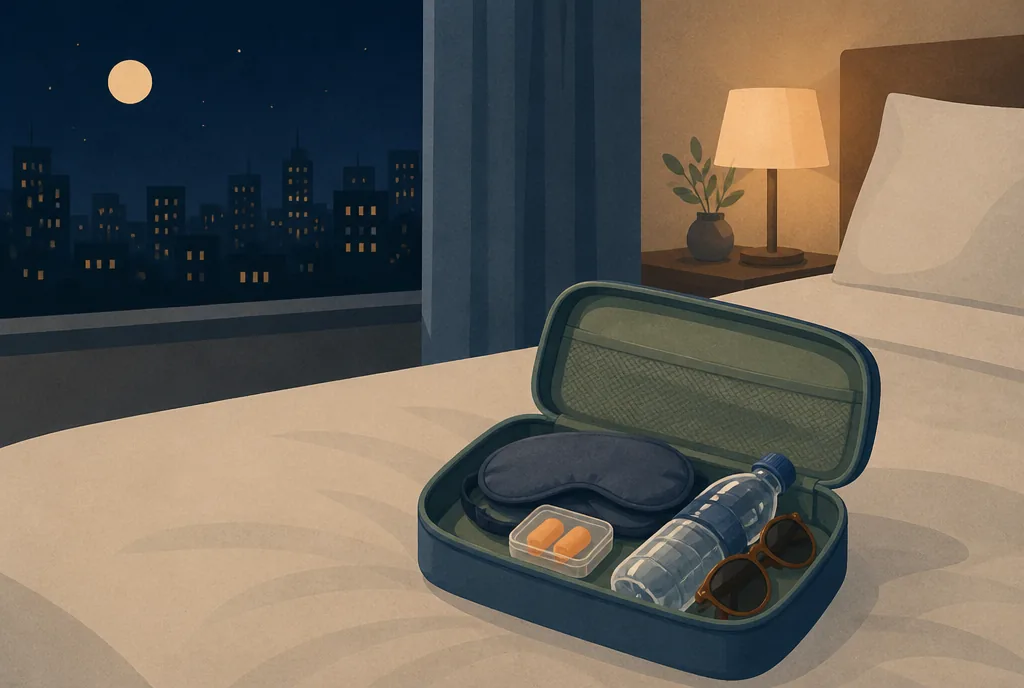
The short answer A good travel sleep kit is small: a contoured eye mask, earplugs that fit you, a white-noise app or small sound machine, a neck pillow you’ve tested at home, a refillable water bottle and layers for a room you can’t control. If you’re crossing time zones, add sunglasses and a plan for when to seek or avoid light. Melatonin is optional and works only if timed right.
Sleeping away from home goes wrong in predictable ways: light you can’t turn off, noise you didn’t choose, a room that’s too warm and a body clock set to the wrong city. Each item below targets one of those. Pack what fixes your usual problem and leave the rest.
| Item | What it fixes | What to look for | Pack if |
|---|---|---|---|
| Contoured eye mask | Cabin lights, hotel curtains that don’t close, early sunrise | Molded eye cups, a nose flap that seals, a wide adjustable strap | Always |
| Earplugs | Engine noise, hallway doors, a snoring roommate | A type you’ve already slept in; spares in a small case | Always |
| White-noise app or small sound machine | Unpredictable noise in hotels and rentals | Works offline, has a steady sound you find easy to ignore | Light sleepers, city hotels |
| Travel neck pillow | Head dropping forward when sleeping upright | Firm enough to hold your chin up; try it at home first | Long flights, trains, car trips as a passenger |
| Refillable water bottle | Dry cabin air, dehydration on long travel days | Empty through security, fill after | Every flight |
| Layers (light sweater, socks) | Cold cabins, rooms you can’t cool or heat well | Something you can add or shed without getting up | Always |
| Sunglasses | Light at the wrong time when you’re crossing time zones | Dark lenses you’ll actually wear in the morning | Trips of 3+ time zones |
| Low-dose melatonin | Jet lag, if timed to your destination | Ask your doctor first; CDC says 0.5 to 1 mg is often enough | Eastward trips across several zones |
| Compression socks | Blood clot risk on long trips for people at higher risk | Below-knee, 15 to 30 mmHg; ask your doctor if you need them | Flights over 6 hours, if your doctor says you’re at increased risk |
| Something familiar | The strangeness of a new room | Your own pillowcase, the same bedtime book | If new places keep you up |
Why the first night away is often the worst
Sleep researchers call it the first-night effect. A 2016 study found a likely reason: on the first night in a new place, one side of the brain stays more alert than the other, like a night watch, and reacts more to unfamiliar sounds. People took longer to fall asleep the more lopsided that alertness was, and it had faded by the next session.
You can’t switch that off, but you can give that watchful half less to react to. That’s the case for the noise and light items above, and for making a hotel room feel a bit more like your own: a familiar pillowcase, the same pre-bed routine, the same book.
Eye mask and earplugs: the core of the kit
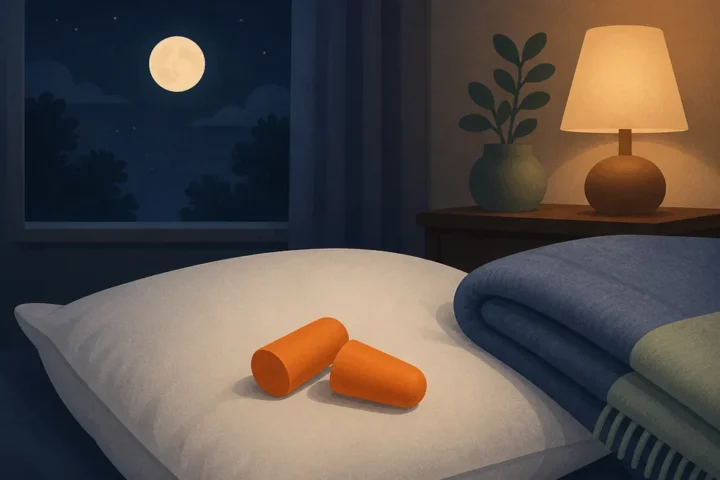
These two do the most for the least space. Most of the clinical research comes from hospital intensive care units, which are about the worst sleeping environments there are. A Cochrane review found low-quality evidence that earplugs, eye masks or both were linked to longer total sleep time in two small trials, though other studies found no benefit on objective sleep measures. That’s not proof they’ll help on a plane, but they’re cheap, safe and easy to test.
The CDC’s jet lag guidance also mentions them: for an early-morning nap on an overnight flight, an eye mask and earplugs may help.
Fit matters more than brand. A mask that leaks light at the nose won’t help at a hotel window at dawn, and earplugs that work your ears loose won’t survive a red-eye. Test both at home before the trip. Our guides cover how to choose a sleep mask and foam vs silicone vs wax earplugs.
Pack earplugs in a small case in your personal bag, not your checked luggage. Spares are worth it; foam plugs get lost under seats and in hotel sheets.
Sound: an app often beats another gadget
Hotel noise is mostly sudden: doors, elevators, voices in the hallway. A steady background sound can make those changes less jarring. Evidence for sound masking is limited; a Cochrane review of hospital studies rated it as low quality, with small improvements in how people rated their sleep. The cost of trying is low.
For most trips a phone app that works offline is enough. A small sound machine makes more sense if you depend on one at home, or if you don’t want your phone near the bed. Our white noise machine guide explains what features matter.
Is a travel neck pillow worth it?
We couldn’t find good trials of neck pillows for sleep, so this one is about comfort, not evidence. The point of a neck pillow is to stop your head from dropping forward or sideways when you doze upright, which is what jolts you awake. A pillow so soft that it flattens under your head can’t do that job. If you buy one, sit upright at home and try napping in it before you trust it on a long-haul flight.
Packing for the time zone, not just the trip
If you’re crossing several time zones, light is your strongest tool, and sunglasses are part of the kit for that reason. The CDC’s jet lag advice runs in both directions. After flying east, get bright light in the early morning and avoid light in the evening. After flying west, avoid bright light in the early morning. Either way, getting daylight at your destination time eases the shift. The CDC estimates people adapt by about 1.5 hours a day after flying west and about 1 hour a day after flying east.
Melatonin can help with jet lag when timed correctly, and more isn’t better. The CDC says 0.5 to 1 mg is often enough to shift your body clock and doesn’t recommend doses above 5 mg. Talk to your doctor before using it, especially if you take other medications; our melatonin dosage guide has the details. Traveling with children adds its own wrinkles, which we cover in jet lag with kids.
What to drink, and what to skip
The CDC suggests staying hydrated, since dehydration can worsen jet lag’s physical symptoms, and notes that minimizing alcohol and caffeine helps you sleep on the plane. That’s why the water bottle earns a spot. Alcohol makes falling asleep easier and the second half of the night worse, a trade that’s especially bad when you’re already short on sleep.
Caffeine is the harder call on a travel day. It’s useful for staying awake until a sensible local bedtime, but a coffee late in the afternoon can still be in your system at night. Our caffeine calculator lets you check, using your destination’s bedtime.
Long flights: comfort and circulation
Sleeping for hours in one cramped position isn’t only uncomfortable. On trips longer than about 4 hours, the CDC notes a higher risk of blood clots for some travelers and says frequent walking and calf exercises are reasonable on long trips. An aisle seat may also help, and it makes getting up easier.
Compression socks are for people at increased risk, not everyone. For long-distance travelers at higher risk on trips over 6 hours, the guidance the CDC cites recommends properly fitted below-the-knee stockings that give 15 to 30 mmHg of pressure at the ankle; for travelers who aren’t at increased risk, they aren’t recommended. Your doctor can tell you which group you’re in.
Making a hotel room work
Once you arrive, a few minutes of setup helps:
- Set the thermostat cool. A Cleveland Clinic sleep psychologist suggests 60 to 67°F (15 to 19°C).
- Close the curtains fully. If they gap in the middle, a clip from your bag can pin them shut.
- Cover or turn away small lights: a TV standby light, a smoke detector glow, a clock.
- Start the white noise before you get into bed.
- Keep your usual bedtime routine, even if it’s shorter.
When to see a doctor
- Talk to your doctor before a long trip if you’ve had a blood clot before, are pregnant, have had recent surgery or have other clot risk factors.
- Ask before using melatonin or any sleep aid if you take other medications, have epilepsy or take blood thinners.
- If you have sleep apnea and use a CPAP, plan for it on the trip rather than leaving it at home.
For more gear guides, including what to look for in masks, earplugs and sound machines, browse Sleep Gear.
Common questions
What should I bring to sleep on a plane?
A contoured eye mask, earplugs, a neck pillow you've tested at home, a refillable water bottle and an extra layer. The CDC notes an eye mask and earplugs may help on overnight flights, and minimizing alcohol and caffeine helps in-flight sleep.
Why can't I sleep the first night in a hotel?
It's called the first-night effect. A 2016 study found one brain hemisphere stays more alert in a new place and reacts more to unfamiliar sounds, which makes it harder to fall asleep. It eases after the first night.
Should I take melatonin when I travel?
It can help with jet lag when timed to your destination, especially after flying east. CDC guidance says 0.5 to 1 mg is often enough and doesn't recommend more than 5 mg. Check with your doctor first.
Do I need compression socks on a long flight?
Only if you're at increased risk of blood clots. Guidance cited by the CDC recommends fitted below-knee stockings of 15 to 30 mmHg for higher-risk travelers on trips over 6 hours, and not for others.
Written and checked by the Sleep Brief editors. We base every article on published research and guidance from medical bodies, and link the sources inline. How we research.
This article is for general education and isn't medical advice. If poor sleep lasts more than a few weeks, or you snore loudly, stop breathing in your sleep or feel sleepy while driving, talk to a doctor.